









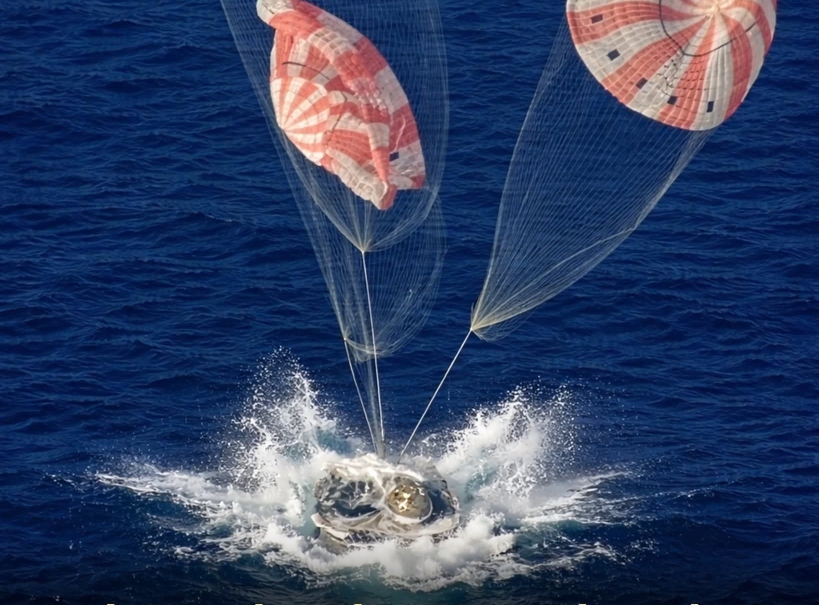
NASA’s Artemis II mission concluded successfully on April 10, 2026, with the Orion spacecraft carrying its four-member crew safely splashing down in the Pacific Ocean off the coast of San Diego, California, at 8:07 p.m.
EDT. The astronauts—NASA’s Reid Wiseman (commander), Victor Glover (pilot), Christina Koch (mission specialist), and Canadian Space Agency astronaut Jeremy Hansen—completed a approximately 10-day journey that marked the first crewed flight beyond low Earth orbit under the Artemis program.
Recovery teams promptly extracted the crew, who were reported to be in good health, and transported them to the USS John P. Murtha for initial medical evaluations.
During the mission, the crew conducted a lunar flyby, venturing farther from Earth than any humans since the Apollo era and capturing unique observations of the Moon’s far side.
The return phase involved a high-speed atmospheric re-entry, during which the Orion capsule endured extreme temperatures, followed by a precisely executed parachute-assisted descent to the ocean surface.
This flawless conclusion validates critical systems tested in deep space and represents a significant milestone toward future lunar exploration objectives.
The successful splashdown underscores the collaborative efforts of NASA, international partners, and recovery personnel in ensuring crew safety throughout the high-risk phases of re-entry and landing.
This achievement paves the way for subsequent Artemis missions, including planned lunar landings, and reinforces ongoing advancements in human spaceflight capabilities. The crew is scheduled to return to NASA’s Johnson Space Center in Houston for further debriefing and analysis.
