









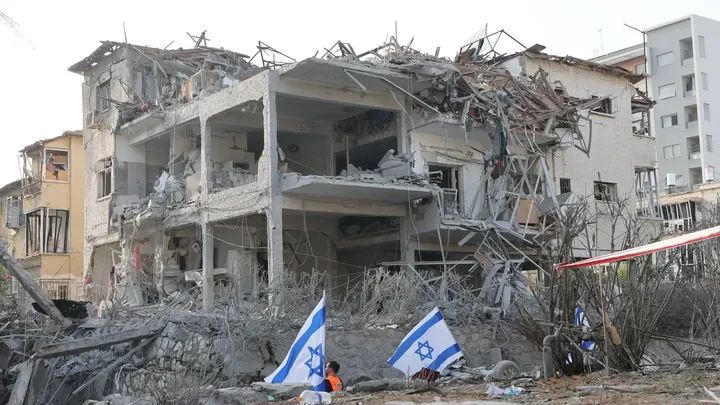
Iran has executed a major missile assault targeting regions near Tel Aviv, employing warheads fitted with cluster munitions in what Iranian officials have described as a measured response to Israel’s recent elimination of prominent security figure Ali Larijani.
The strikes, which took place overnight on Tuesday, claimed the lives of two civilians in a residential district adjacent to Tel Aviv—an area that also contains key military infrastructure.
This latest incident has increased Israel’s reported civilian fatalities from the continuing conflict to a minimum of 14.
The Islamic Revolutionary Guard Corps publicly confirmed through state television that the operation utilized sophisticated ballistic missiles, notably the Khorramshahr-4 and Qadr variants, both capable of releasing multiple submunitions during flight to complicate defensive intercepts.
These cluster configurations enable wide-area coverage by dispersing smaller explosives mid-air.
The attack comes shortly after Iran verified Larijani’s death in an Israeli operation, along with the separate killings of his son and his deputy, Alireza Bayat, in a prior strike.
As one of the most senior officials lost since the conflict erupted with the assassination of Supreme Leader Ayatollah Ali Khamenei, Larijani’s death marks a significant escalation in the targeting of Iran’s leadership structure.
Tensions remain elevated across the region, underscored by a reported projectile impact near Iran’s Bushehr nuclear facility on Tuesday evening, although no injuries or damage were recorded.
The International Atomic Energy Agency has issued an urgent appeal for restraint to safeguard against any potential nuclear incident. Under the new leadership of Mojtaba Khamenei, Iran has categorically rejected proposals for de-escalation or ceasefire negotiations involving the United States, indicating that the cycle of retaliatory strikes is likely to persist in the foreseeable future.
